

“Whoever solves the attribution problem is going to make a fortune.”
From 2014 to 2024, I was actively “selling” attribution internationally. I’m not exaggerating when I say I’ve spoken with more than 2,000 marketing leaders, all looking for the answer to the same question:
“I need to know how to allocate my marketing budget to sell more.”
That’s what Adinton does. It’s still alive and has clients. But I’m no longer its commercial engine.
THE PROBLEM (If you’re in Europe, pay attention)
This is your business’s REAL funnel:
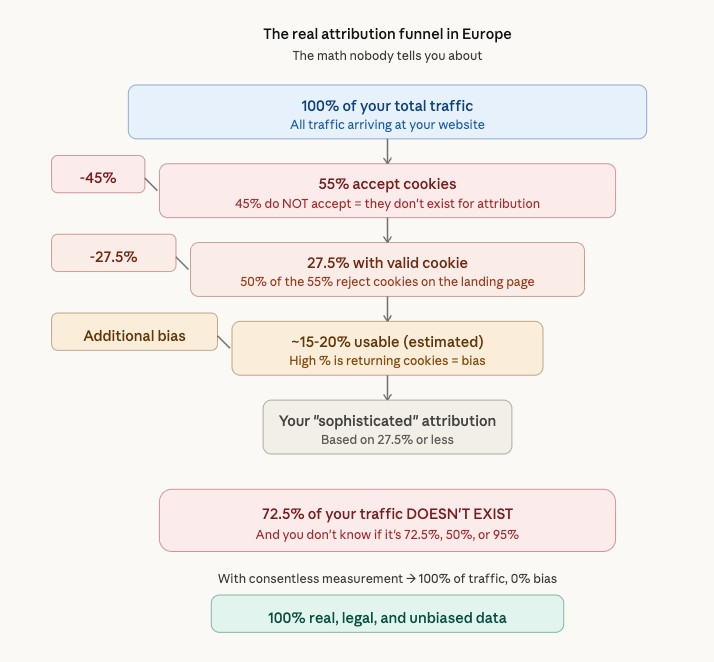
45% of your traffic does NOT accept cookies = Attribution doesn’t exist.
Of the 55% who accept cookies, 50% don’t accept them on the landing page = Wrongly attributed to Direct traffic.
We’re talking about attribution based on 27.5% of your total traffic.
You might think 27.5% isn’t that bad. But it’s absurd. Why? Because 45% — double that amount — doesn’t accept cookies and you’re NOT solving it. So why do you want attribution from 27.5% when you’re missing 72.5%?
Of that 27.5%, a high percentage is returning cookies. Users who already interacted with your brand. Hence, bias.
This is math. And it’s clear.
THE JOURNEY: Who’s selling you attribution (and why)
But there will always, always, be a current of:
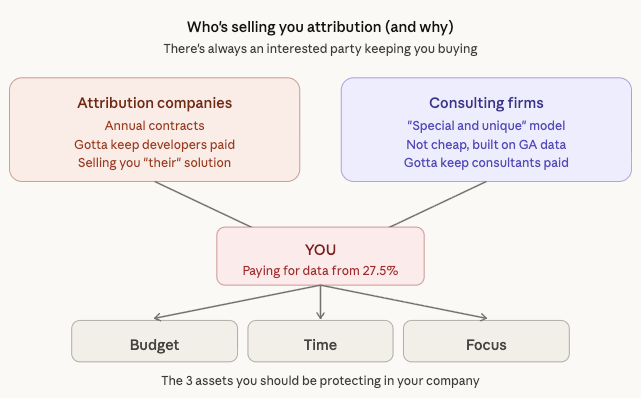
Attribution companies who want to sell you their solution. That’s why the vast majority are annual contracts. Gotta keep developers paid.
Consulting firms who build a “special and unique” model just for you. Not cheap, built on Google Analytics data. Gotta keep consultants paid.
WHEN TO RUN: The Red Flags
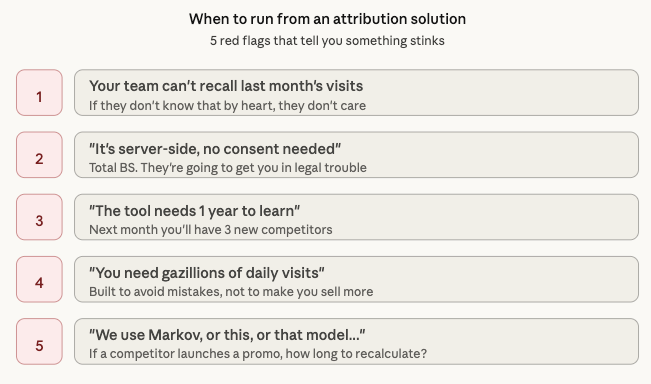
Your team can’t recall last month’s traffic. If they can’t answer that from memory, they don’t care about attribution, visits, or your business. 100% of the demos where I asked “How many visits did you get last month?” and they couldn’t answer quickly — they NEVER bought the tool.
“It’s server-side tracking, no consent needed.” Wrong! Total BS! Alert! Your provider is going to get you in legal trouble.
“The tool needs 1 year to learn.” 1 year? Next month I’ll already have 1, 2, 3 more competitors that will completely change my reality.
“You need a minimum of gazillions of daily visits.” A model that requires that much data is designed to avoid mistakes, not to help you sell more. Would you rather have an agile business or a heavy one?
“We use Markov, or this other model, or that one...” Ask them: if my competitor launches a massive promo or a new product, how long does the algorithm take to recalculate?
THE REALITY (What I learned analyzing thousands of customer journeys)
This comes from someone who’s geeky enough to have analyzed, studied, THOUSANDS of customer journeys:
Human beings browse however they damn well please. They’re completely free.
The marketer, out of ignorance of what attribution really is, asks for: “The typical journey: enters through PPC, then SEO, then email, and buys.”
That journey happens 2% of the time or less. Statistically without basis.
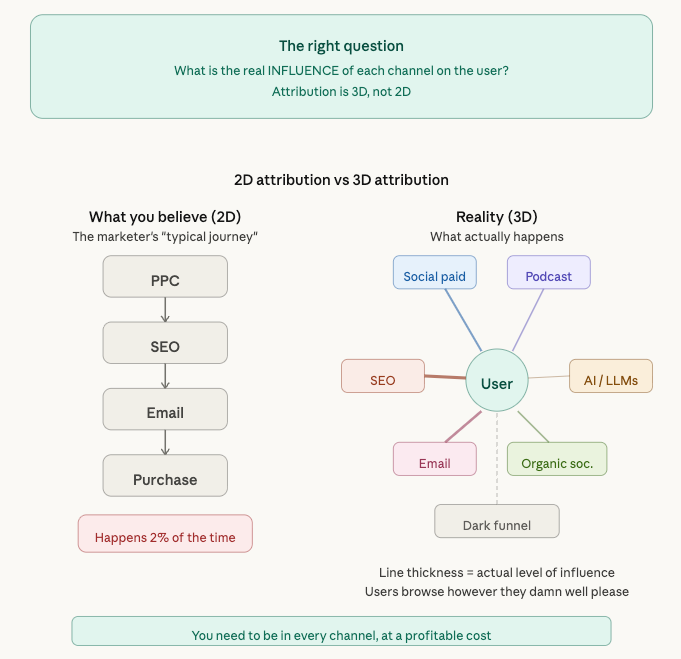
The reality, as a marketer (not as an analyst):
You need to be in every single channel. ALL of them. But at a cost that’s profitable.
The key to attribution, when you have a statistical base that supports it in both volume and navigation quality, is knowing the INFLUENCE of a channel on the user.
THE CHANNEL THAT DOESN’T CONVERT
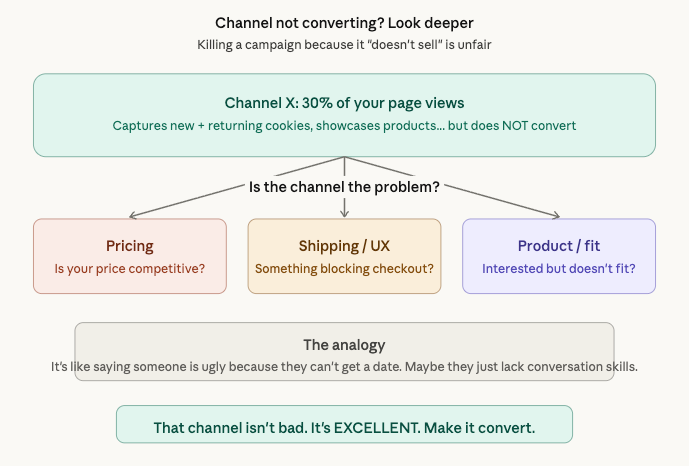
If you have a channel generating 30% of your page views, capturing new and returning cookies, showcasing your products, but NOT converting... is the problem with the channel? Or is it the pricing, the shipping costs, the UX...?
That channel isn’t bad. It’s EXCELLENT. You need to make it convert.
It’s like saying someone is ugly because they can’t get a date. Maybe they just lack conversation skills.
Marketers think about attribution in 2 dimensions. Reality has 3. There are many variables at play.
THE DARK FUNNEL
And we haven’t even talked about this:
How much traffic do your Social Paid and Organic impressions generate?
How many sales or visits did your podcast interview generate?
How much traffic does the AI that’s talking about your company generate?
THE LESSON
Look, I’ll be honest with you.
I can’t conceive of my professional life as a marketer without an attribution model adapted to my business (as long as what I bill, and its growth projection, supports it).
But having an attribution model based on 27.5% is garbage. It’s useless. All it does is burn budget, time, and focus. Those are the 3 assets you should be protecting in a company.
And what’s even worse: you don’t know if it’s 27.5%, 35%, 50%, or 5%... because you don’t know the real total of your traffic.
I’m not anti-attribution. Quite the opposite. I’ve invested time, money, resources, and focus into an attribution tool. And since I saw GDPR coming, I shifted my strategy to markets outside Europe where I could start with 100% of data tracked.
So, however long your customer journey is, however non-impulsive your purchase may be... if you’re in Europe, don’t burn money, time, or focus on sophisticated attribution based on 27.5% of your traffic.
First, make sure you’re measuring 100%.