

The most expensive lie you tell yourself as an entrepreneur
By Rafa Jiménez
Everyone talks about focus.
Books, podcasts, Twitter threads, conferences. “The key is to stay focused.” Right. Thanks. Very helpful.
The problem isn’t that nobody tells you. The problem is that knowing it is useless. Because focus isn’t a concept you understand. It’s a discipline you practice. And practicing it hurts.
I’d say it’s the hardest part of building a company. Not because it’s complex, but because it goes against everything that makes you an entrepreneur in the first place.
The enemy isn’t a lack of ideas. It’s the excess.
When you build something, your brain becomes an idea factory. Every customer conversation opens a door. Every podcast inspires a pivot. Every competitor launch creates urgency.
And you — a capable person (if you weren’t, you wouldn’t be building) — see opportunities where others see noise.
That’s exactly the problem.
Because the ability to see opportunities without the discipline to ignore most of them isn’t a strength.
It’s a trap.
The focus trap has a name
The interesting thing is that lack of focus doesn’t look the same in every role. But the result is always the same: lots of noise, little impact.
If you’re a Founder, your trap is trying to be everything at once. Product, sales, marketing, operations, culture. You believe that if you’re not on top of every piece, it falls apart. And maybe that was true at the beginning. But there comes a point where your presence in everything is exactly what prevents anything from working without you. Your company doesn’t scale because you don’t let go.
If you’re a CMO or leading marketing, your trap is the shiny new channel. SEO, paid, content, influencers, partnerships, events, webinars, TikTok, podcasts… every week there’s a channel you “should be testing.” And the pressure to prove ROI fast pushes you to spread budget across 8 channels instead of mastering 2. The result: presence everywhere, traction nowhere.
If you’re in the C-suite (COO, VP, C-level), your trap is the meeting. Your calendar is packed with “alignment sessions” and “syncs” that give you the illusion of progress. But at the end of the quarter you look at your OKRs and nothing has actually moved. Because being informed is not the same as being focused. And most meetings are about the former, not the latter.
The pattern is universal: the more capable you are, the more things you can do. And the more things you can do, the harder it is to choose the few that matter.
Geoffrey Moore already said it: this is a crisis
In Zone to Win, Geof
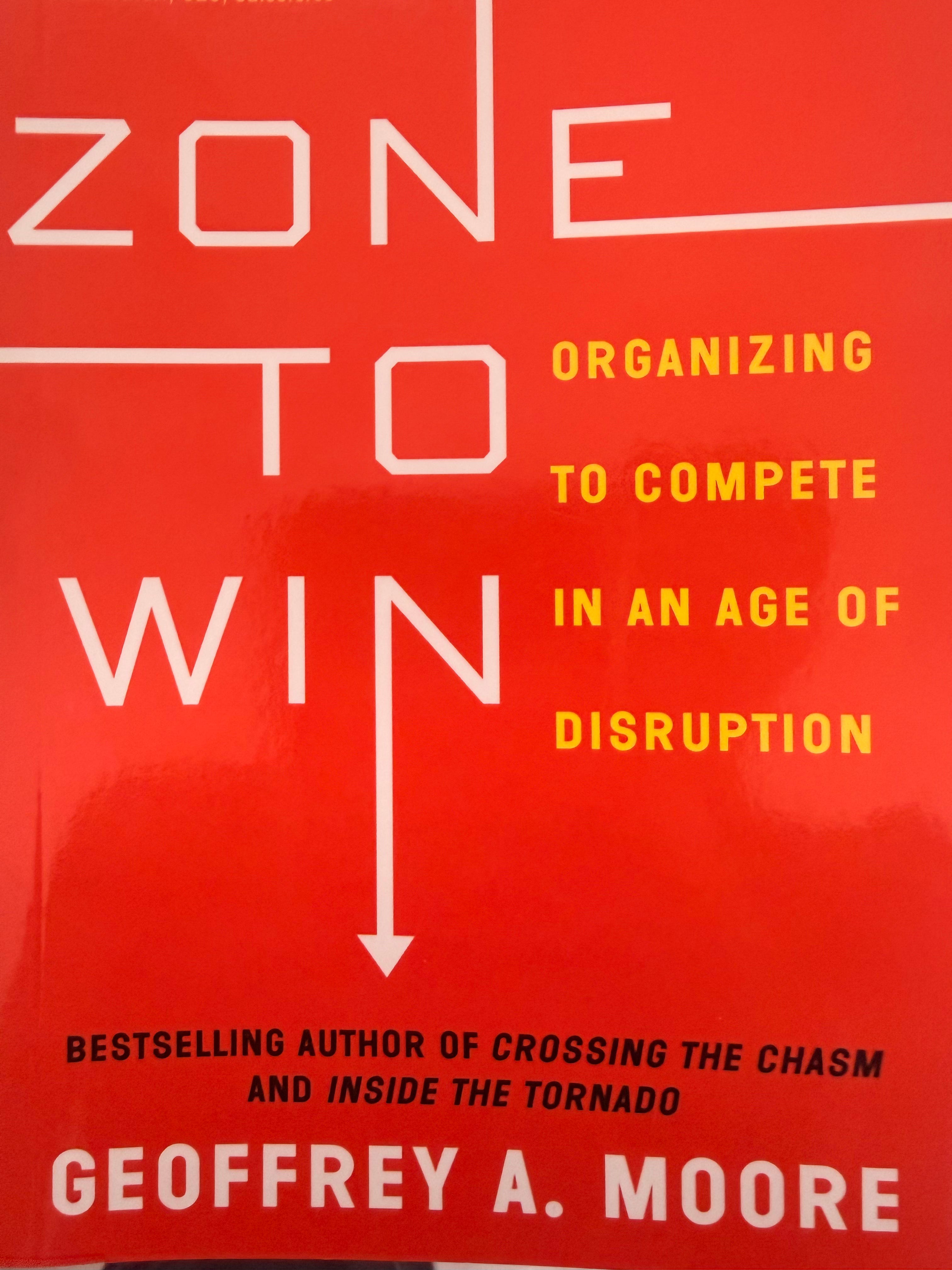
frey Moore dedicates his first chapter to something he calls “A Crisis of Prioritization.” And while Moore is talking about large tech companies, the lesson applies just as much to startups, scale-ups, and anyone leading a team.
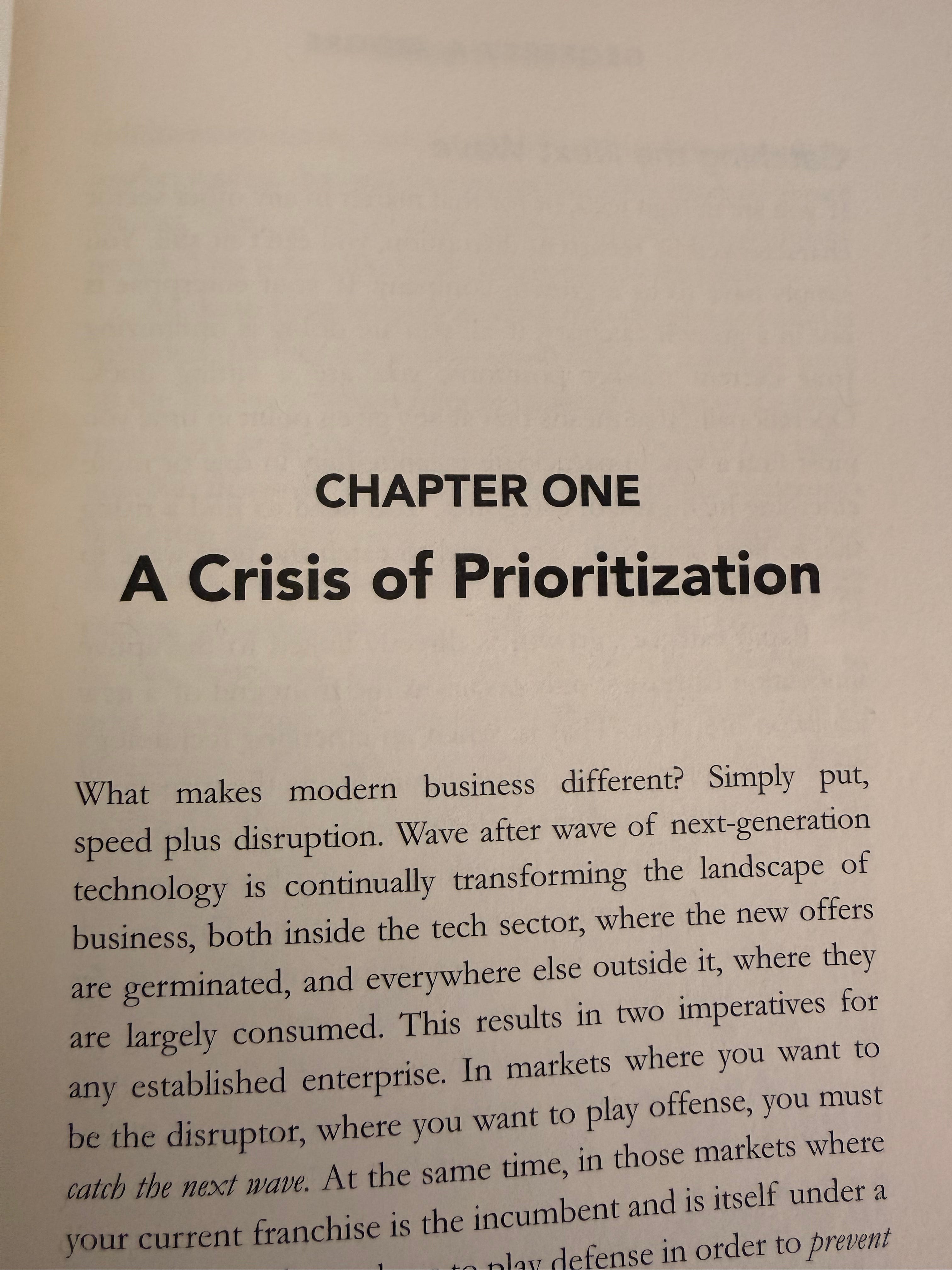
His argument is devastating: disruptive innovations — whether they come from outside or you initiate them yourself — create a crisis of prioritization because there are never enough resources for everything. And the question most people avoid answering is: how much of what I have do I keep investing in what already works, and how much do I divert into what’s new?
Moore gives examples that sting. Companies with brilliant management teams — Nokia, Netscape, 3Com — that didn’t die from lack of talent or money. They died because they couldn’t manage that crisis of prioritization. They tried to be everywhere and mastered nothing.
And here’s the part that hit me hardest: Moore says the CEO must choose ONE — and only one — transformational initiative. Not two. Not three. One. Because putting two transformational initiatives in the transformation zone at the same time is, in his words, a “showstopper.” They cancel each other out.
Think about that. If a company with thousands of employees can only afford ONE big bet at a time, what makes you think that you — as a founder or CMO with limited resources — can chase five?
The crisis of prioritization isn’t a big-company problem. It’s THE problem for anyone who wants to build something that matters. And the solution isn’t more resources. It’s more discipline to choose.
What nobody wants to hear
Focus isn’t choosing what you do.
Focus is choosing what you DON’T do.
It’s saying no to that client who asks for a feature that takes you off the roadmap. It’s not opening that second acquisition channel when you haven’t mastered the first one. It’s resisting the temptation to build what’s fun and building what’s necessary instead.
And it hurts. Because every “no” feels like a missed opportunity.
But here’s the uncomfortable truth: companies don’t die from a lack of opportunities. They die from chasing too many at once.
The brutal focus test
Ask yourself this right now:
If you could only work on ONE thing for the next 90 days — one single thing that would move the needle in your business — what would it be?
If it takes you more than 5 seconds to answer, you don’t have focus.
And that’s okay. It’s not a judgment. It’s a diagnosis. And diagnoses are the first step to getting better.
What I’ve learned (the hard way)
I’ve had weeks where I played CEO, CMO, sales, support, product, and strategy — and by Friday I felt like I hadn’t moved forward on anything.
Lots of motion. Zero progress.
The feeling is the worst: you’re exhausted, you’ve worked 60 hours, and you can’t point to ONE thing that actually changed in your business. Because you spread your energy across 14 fronts and on none of them did you go deep enough for anything to happen.
The lesson was brutal but necessary: speed without direction is just agitation.
Focus isn’t sexy. But it’s what works.
Nobody’s going to post on LinkedIn saying “Today I said no to 7 ideas that seemed great.” There’s no applause for quiet discipline.
But the entrepreneurs who win — the ones who actually build something that lasts — share one trait. They’re not the smartest, or the hardest working, or the ones with the best product.
They’re the ones who best choose where to put their limited energy.
Because energy is finite. Time is finite. Attention is finite.
And the market doesn’t reward whoever does the most things. It rewards whoever does ONE thing better than anyone else.
Your assignment this week
I’m not going to give you a 12-step framework. I’m going to give you one step:
Write on a piece of paper the most important thing you need to achieve in the next 90 days.
One single thing.
And every time something new feels urgent, look at that paper.
If it doesn’t contribute to that thing, it’s noise. And noise, no matter how good it sounds, is still noise.
Focus-hack: how to train focus with discipline
Knowing you need focus is easy. Maintaining it on a Tuesday at 11am when a brilliant idea hits you — that’s a different story. Here are tactics that work for me:
1. The “not yet” rule Every new idea that comes your way, don’t kill it. Write it on a list called “Not yet.” It’s not a no. It’s a “now is not the time.” This takes the anxiety out of your brain without derailing your execution. Review it every 90 days. You’ll be surprised how many ideas that felt urgent make zero sense three months later.
2. The filter question Before saying yes to anything, ask yourself one question: “If this works out, does it get me closer to my 90-day goal?” If the answer isn’t an immediate yes, it’s a no. It sounds radical. It is. But the alternative is saying yes to everything and finishing nothing.
3. Block the doing, not just the thinking Focus doesn’t live in your head. It lives in your calendar. If your #1 priority doesn’t have time blocks reserved in your schedule, it’s not a priority. It’s a wish. I block a minimum of 3 hours a day for pure execution. No Slack, no email, no “just one quick thing.” Those 3 hours produce more than the other 8 combined.
4. Weekly 10-minute audit Every Friday, before closing shop, answer this: “What percentage of my time this week went to my #1 goal?” If it’s less than 50%, something is wrong. You don’t need more hours. You need fewer distractions disguised as work.
5. Make your focus public Tell your team, your co-founder, your partner what your single priority is. When others know, they protect you from yourself. And when they see you drifting, they remind you. This hack is uncomfortable because it makes you accountable. And that’s why it works.
6. The “anti-roadmap” I do this every quarter. In addition to deciding what I’m going to do, I explicitly write down what I’m NOT going to do. And I share it. “This quarter we are NOT opening a paid channel. We are NOT launching feature X. We are NOT going after segment Y.” It seems unnecessary. But when temptation comes (and it will), having the “no” in writing gives you the strength to stick to it.
A final thought for those who lead teams
If you lead people, your lack of focus doesn’t just affect you. It multiplies.
Every time you shift priorities, your team gets the message that whatever came before didn’t matter. Every “new urgency” erodes their trust that the plan makes sense. And after a few months, your team stops committing to goals because they know those goals will change before they can reach them.
A leader’s focus isn’t just a matter of personal productivity. It’s an act of respect toward the people who execute.
When you have focus, your team can have it. When you jump from one thing to another, your team learns that the plan is a suggestion, not a commitment.
The question isn’t just “What do I focus on?” It’s “What am I asking my team to stop doing so the important thing can happen?”
Focus isn’t found. It’s defended. Every day. Against everything that shines.